The craft
A joint you can read from across the room.
Our frames hold together the way frames held together four hundred years ago: wood into wood, pinned with a peg. Here is what that means and why we bother.
Why timber frame
The structure is the finish.
A conventional house hides its bones behind drywall. A timber frame puts them in the room with you: posts you brush past in the hallway, trusses overhead at dinner, a ridge beam running the length of the house like a keel.
That honesty has practical teeth. Heavy timber outlasts stick framing, chars slowly instead of failing fast in fire, and carries roofs across wide rooms without interior walls, which is why our floor plans stay open decades after trends move on.
And because the joints are wood, the frame moves with the seasons instead of cracking against them. It ticks and settles its first winter, then goes quiet.
The joints, by name
Four joints do most of the work.
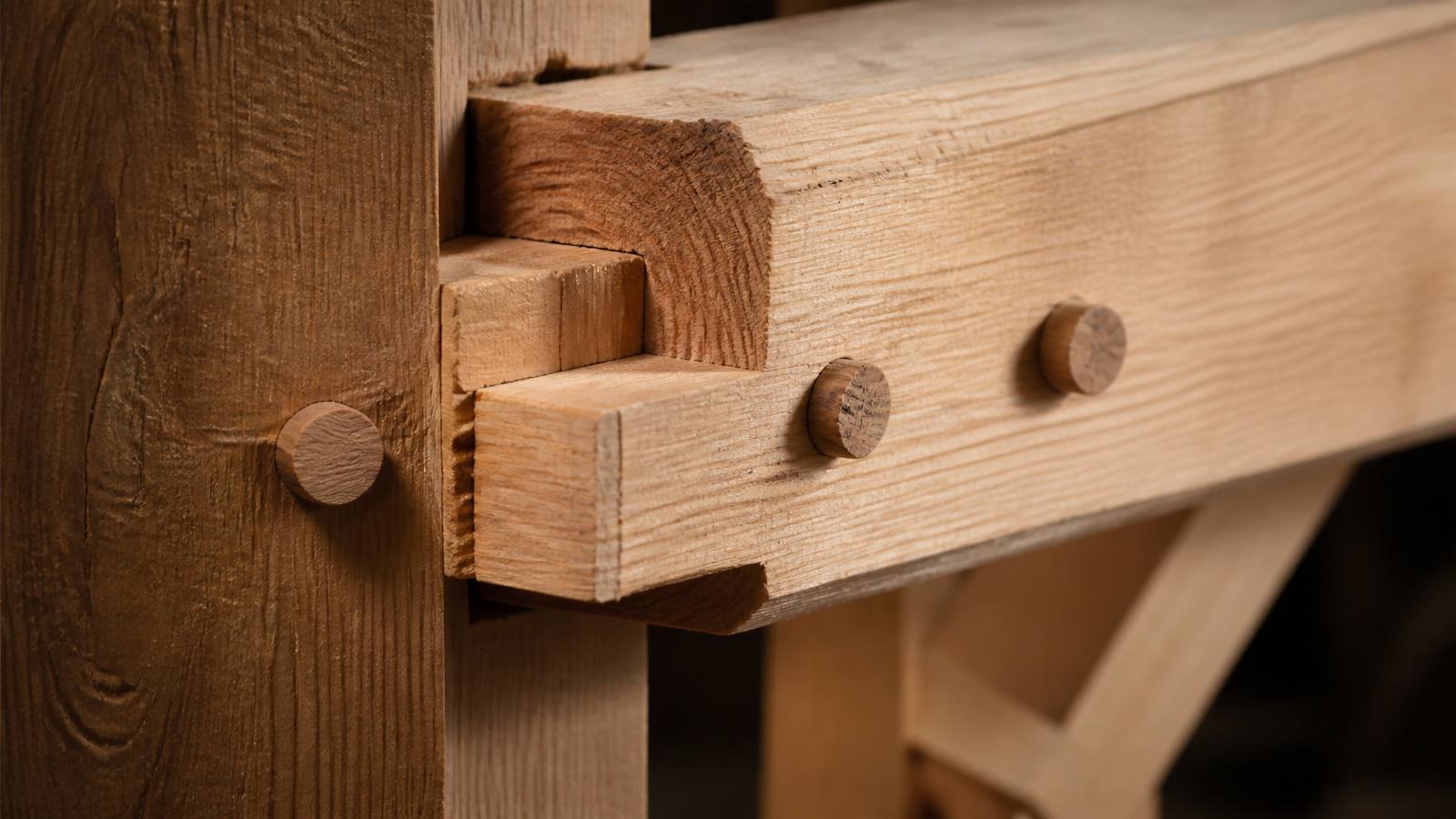
- Mortise and tenonThe workhorse: a tongue on one timber seated in a pocket on the other, pinned through with pegs. Nearly every post-to-beam connection in our frames is a variation on this joint.
- White oak pegsInch-thick trunnels driven through offset holes so the joint pulls itself tight. No steel plates where a timber joint does the job; the peg is the fastener.
- Knee bracesThe short diagonals between post and beam. They look decorative; they are what keeps the frame square when a Bridger Canyon gust leans on the gable.
- Scarf jointsHow two timbers become one long one when a ridge runs farther than a tree grows. Cut right, a scarf carries load and reads as a single line of grain.
The wood
Three timbers, chosen on purpose.
- Douglas fir
The backbone of every frame we cut: stiff, straight-grained, and strong for its weight. Most of ours comes in from Pacific Northwest mills, free of heart center and graded for structure.
- Western larch
Our namesake. A Montana native that is heavy, tight-grained, and stubborn about rot, which makes it our first choice for siding, decks, and porch frames. Left unfinished it weathers to silver.
- Reclaimed timber
Salvage from barns and snowsheds when a client wants wood with a previous life. It costs more to work, checks and all, and it is worth it about half the time; we will tell you which half yours is.
“Every timber gets test-fit on the shop floor before it ships. Raising week is not the time to find out a tenon is proud an eighth of an inch.”Dane Kirkeby · Co-founder, head of the frame shop
Come see a frame being cut.
The shop in Four Corners is open to serious clients most Fridays. Watching a joint come together tells you more about us than any website can.
Arrange a shop visit